UI/UX Design: For the Chores Nobody Sees
A calm home for invisible work
In most homes, one person keeps the list. They notice the filter is due, they remember to water the plants, and they decide whether the fridge can wait another week. Sociologists call this cognitive household labor, and it usually lands on one person by default.
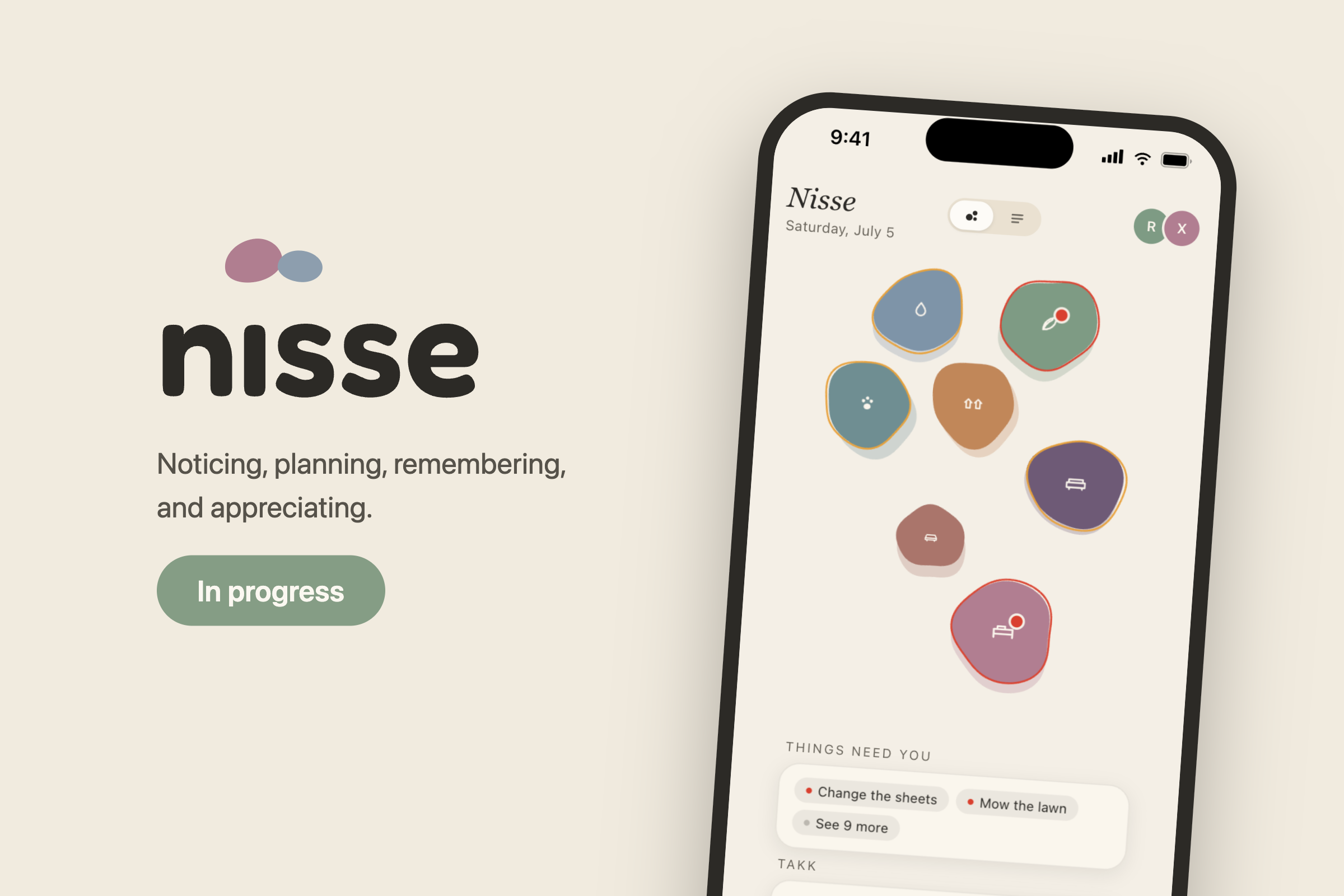
And yet the world mostly counts you as a team. Your neighbors know you as a house number. You arrive at a double date as a pair. You are somebody’s parent, or the pet’s pawrent. What keeps that team standing is exactly the work nobody sees. Nisse is a home management app built to share it, so that two people can notice, plan, and remember together, and each can appreciate the invisible work the other one is carrying.
How do you make invisible work visible,
without turning a relationship into a scoreboard?
What existing tools get wrong
I mapped twenty products across seven kinds of tool, all built for adults sharing a home, against two questions: who does the noticing, and when does a task get an owner. Four patterns kept showing up.
There is always an admin

There is always an admin
Nearly every tool models a household as one owner handing work down. Whoever sets the app up becomes the manager all over again, because the software quietly hands them the clipboard.
We think a home has no admin. In Nisse the account belongs to the household itself, and nobody holds the clipboard.
Ownership gets fixed too early
Ownership gets fixed too early
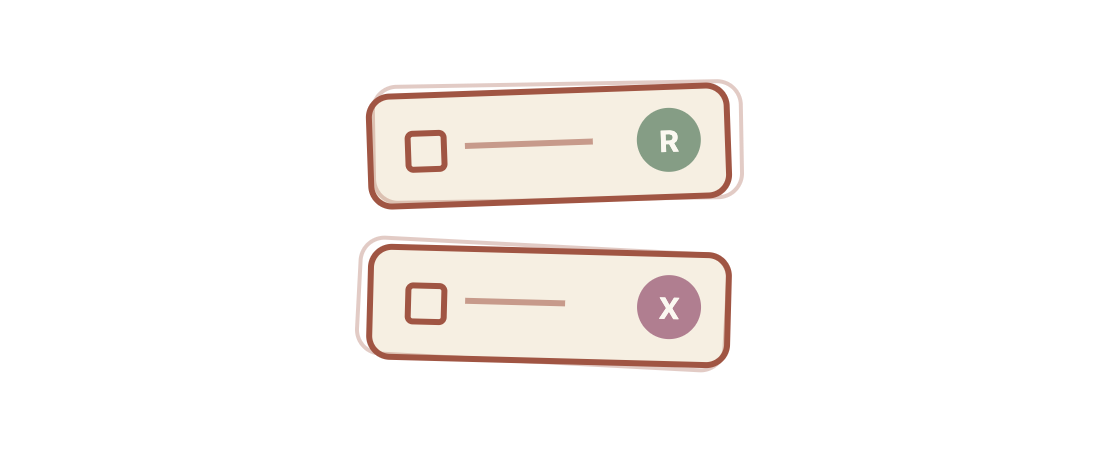
One partner notices something, decides it matters, then passes the doing along. An assignee field turns that pattern into a feature and calls it teamwork, but the noticing never moves.
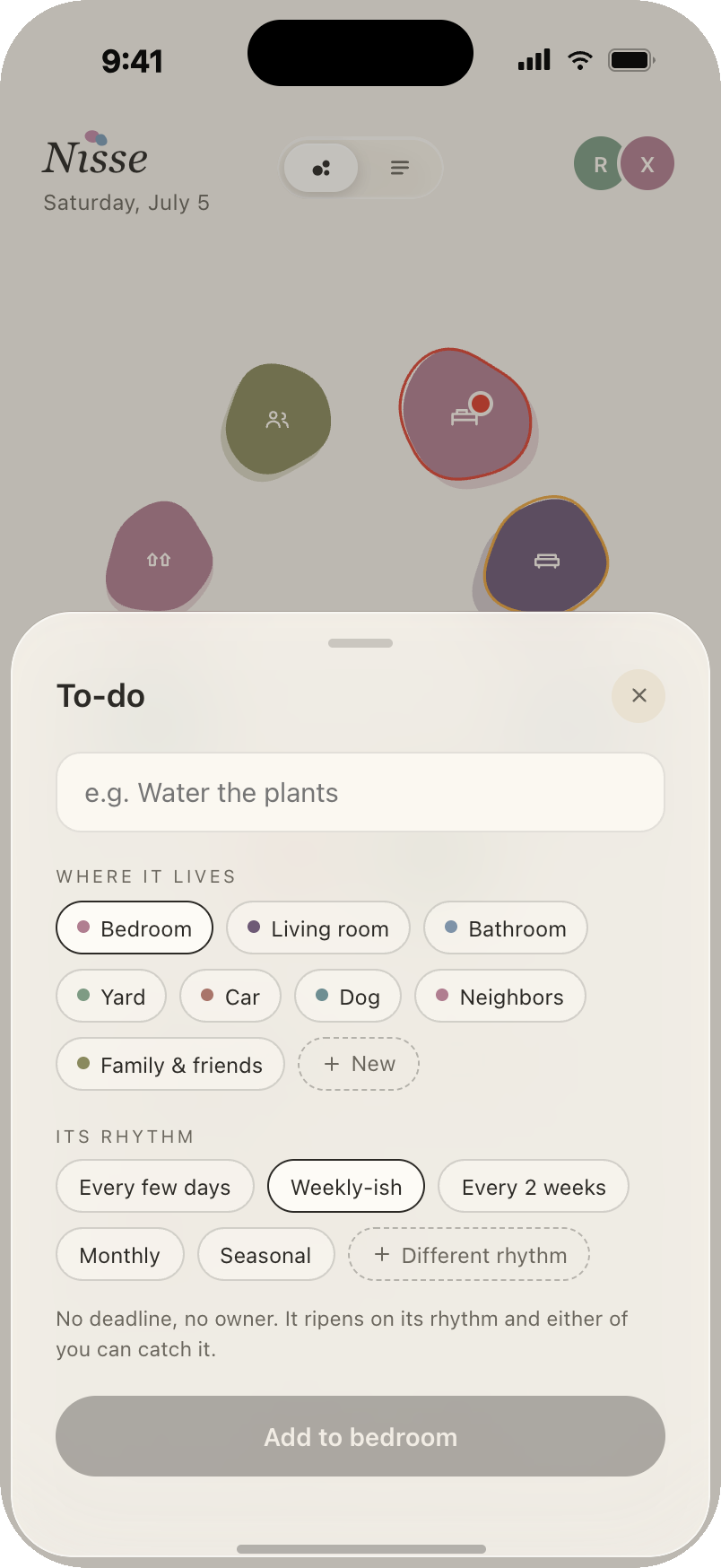
We think nothing should carry a name until someone picks it up. Ownership gets claimed at the moment of doing rather than assigned at the moment of creation.
Pressure stands in for care
Pressure stands in for care
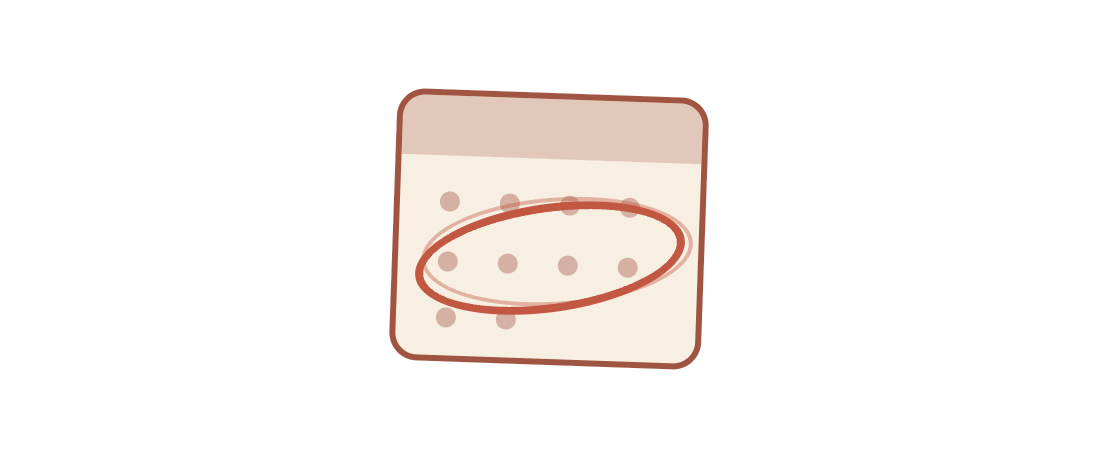
Cleaning the windows is not really due Tuesday at 9:00. It is due roughly this month. Hard dates invent failure in a home that is doing fine, and points and leaderboards turn care into currency and partners into rivals.
We think housework has a rhythm rather than a deadline, and that fairness should be a mirror two people look at together instead of a game one of them wins.
A smarter manager is still a manager

A smarter manager is still a manager
The best funded answer is to let an assistant do the noticing. But an assistant still has to hand the work to somebody, so it assigns, and your partner ends up holding a notification instead of an understanding of the home.
We never wanted to delete the noticing. We wanted two people to share it.
One of these apps has a glowing review that captures the problem exactly: “Nice to be able to assign tasks to my husband and get them off my mental load.”
That is a real win for her, but look at what stayed the same. She still noticed the task, decided it mattered, and chose who would do it. The management never left her head.
Nisse aims further: a home where the noticing is shared from the start, so nobody keeps the list and nobody gets handed one.
The core concept: a shared pool, in soft time
In Nisse, tasks belong to nobody when they are created. They sit in a shared household pool where both partners can see them, and they take an owner only when somebody claims them. That one structural choice removes the delegation dynamic entirely. Nobody hands out work and nobody nags. The question shifts from “did you do what I asked” to “what does our home need, and what will I pick up.”
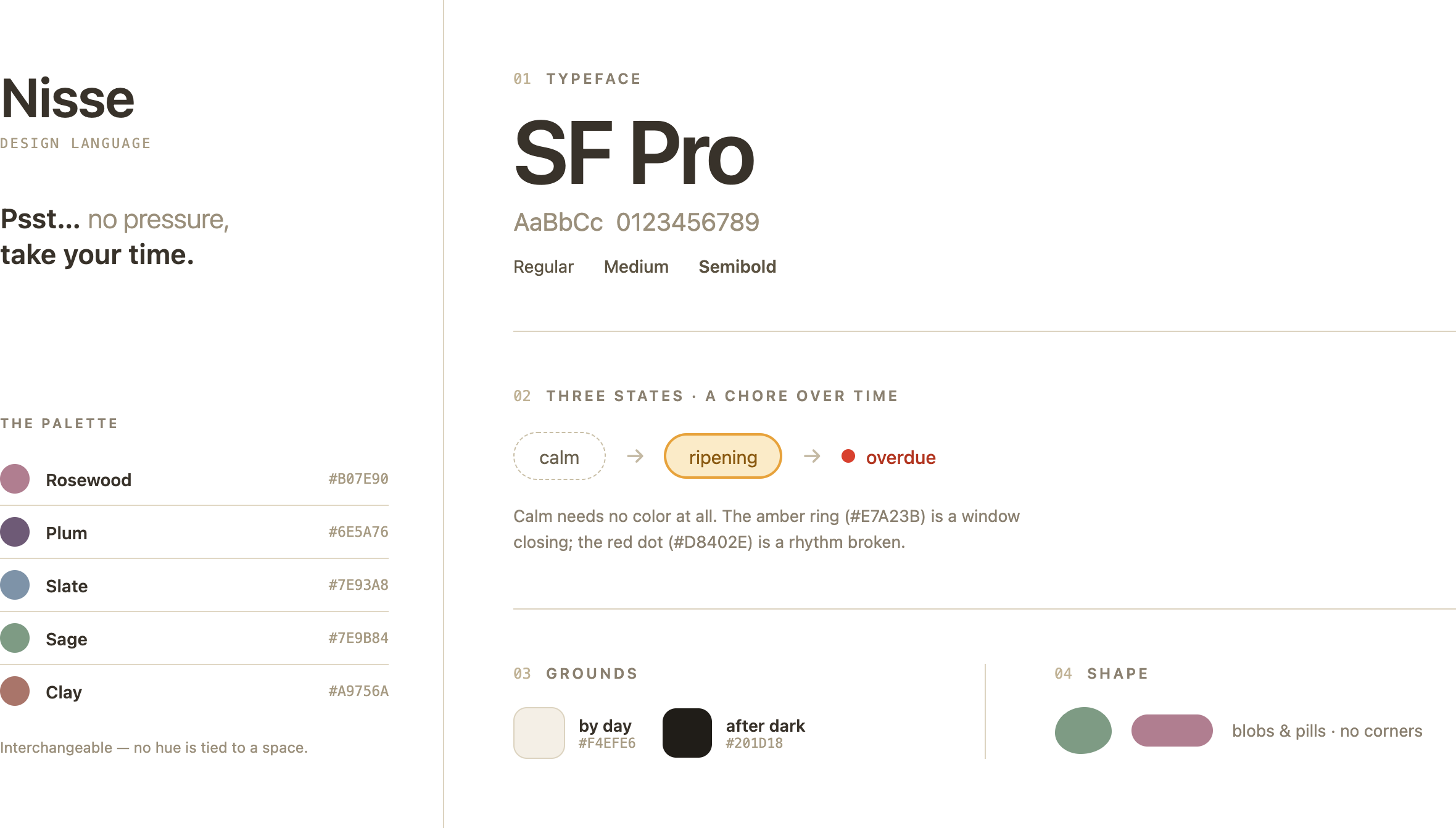
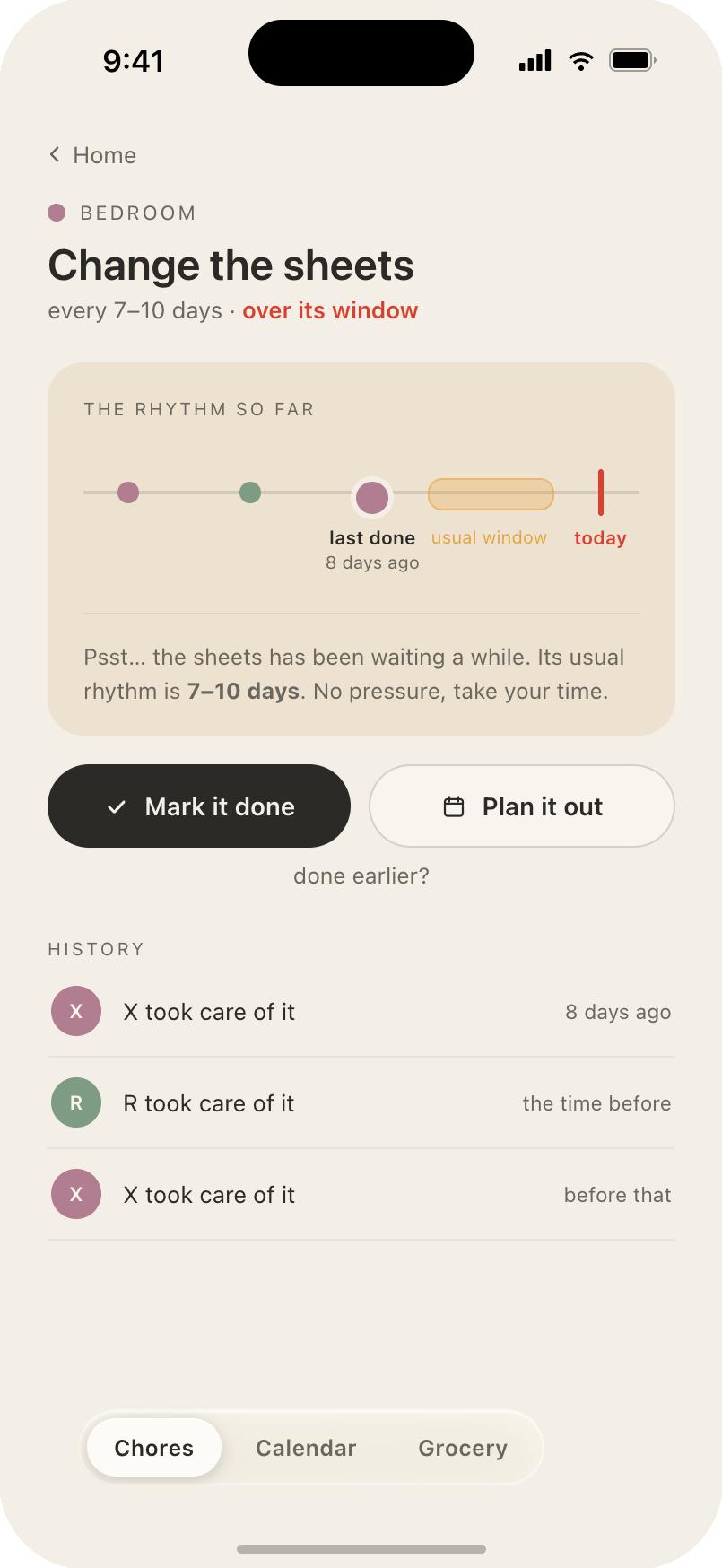
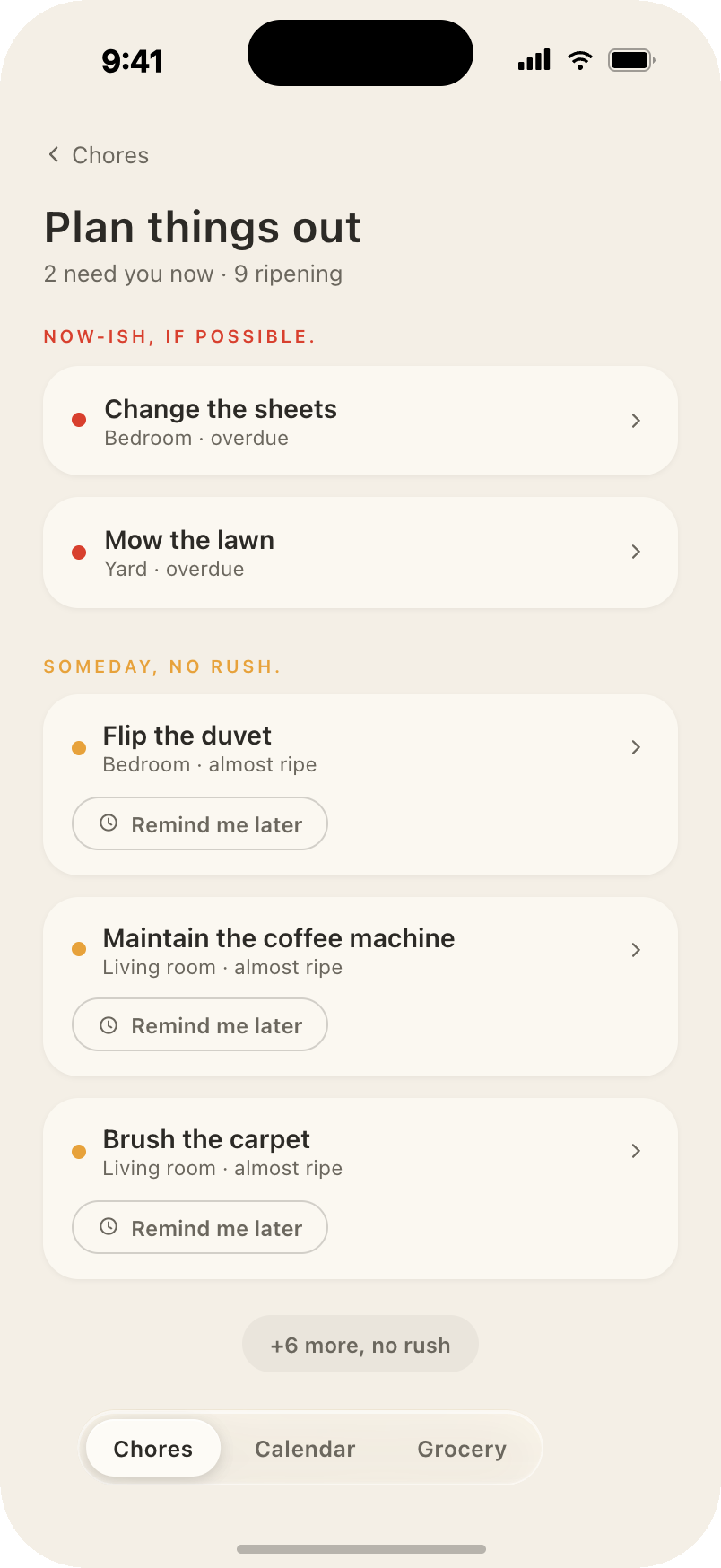
Recurring chores carry a rhythm instead of a deadline. Most chores have no real due date anyway. Nobody needs the windows washed by the 14th; you just need to remember the windows exist and not let them slide forever. Most apps fail right here, because the moment they remind you, you are already overdue, so the reminder itself tells you that you failed. Nisse gives each chore a window instead. Inside it, the task floats freely and its state warms gently as the window ripens. Only a genuinely broken rhythm turns red. A passing Tuesday never does.
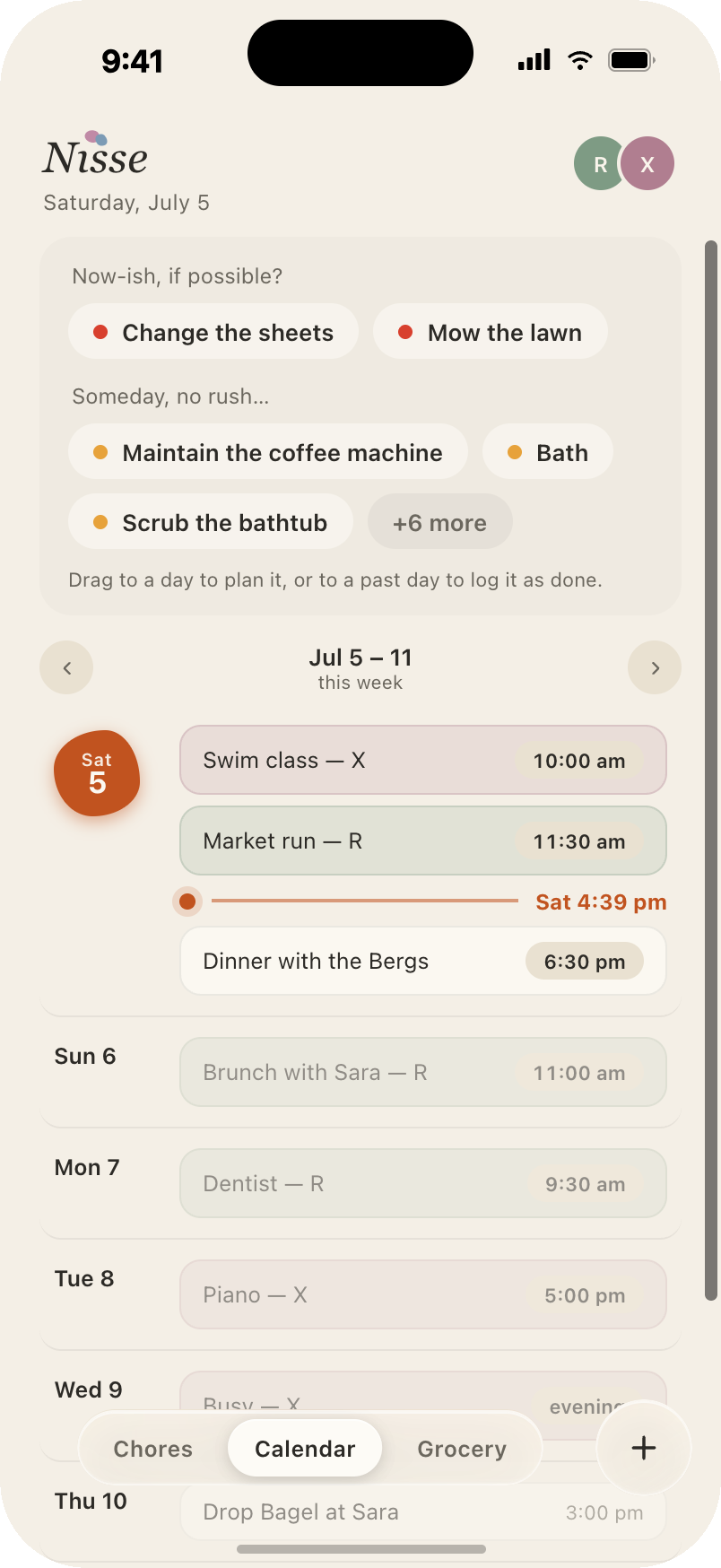
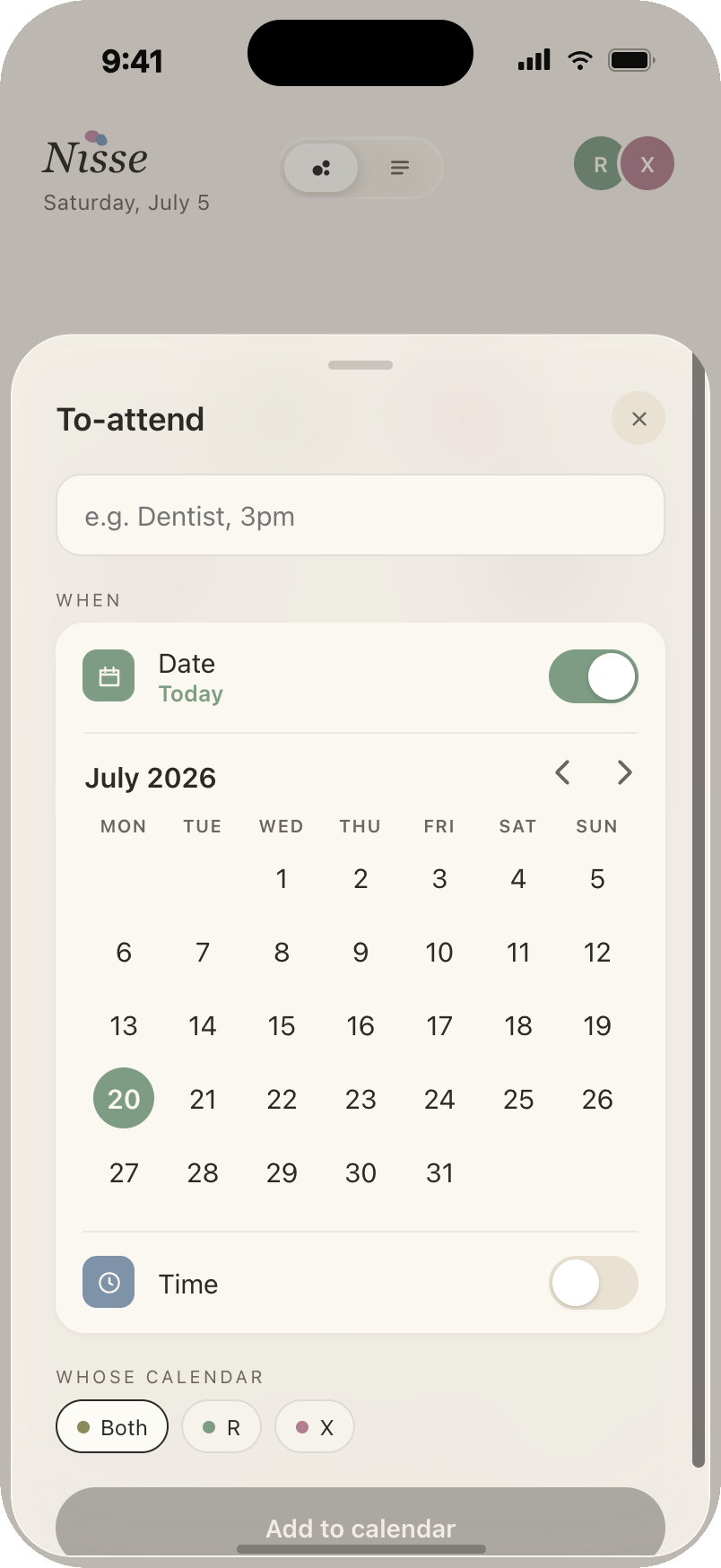
Nisse also learns how you actually live. If the plants get watered every ten days instead of seven, the window stretches to match, rather than holding you to a schedule you invented once and never meant literally. When life demands a real date, any floating task can be fixed to the calendar. Guests arrive Saturday, so the big cleaning gets settled.
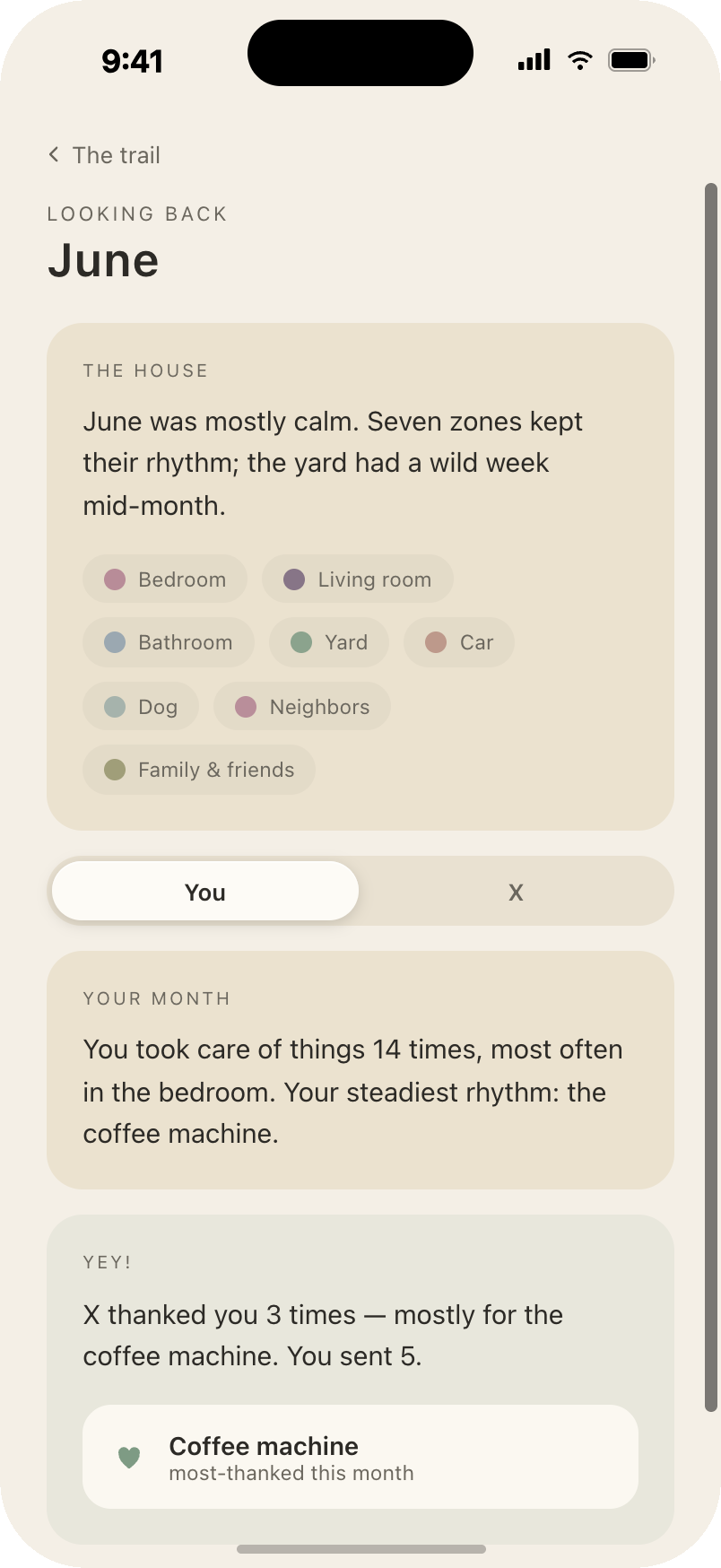
Once a month, Nisse offers a gentle look back at how the household’s work actually distributed itself. It reads like a conversation starter for two adults rather than a verdict.
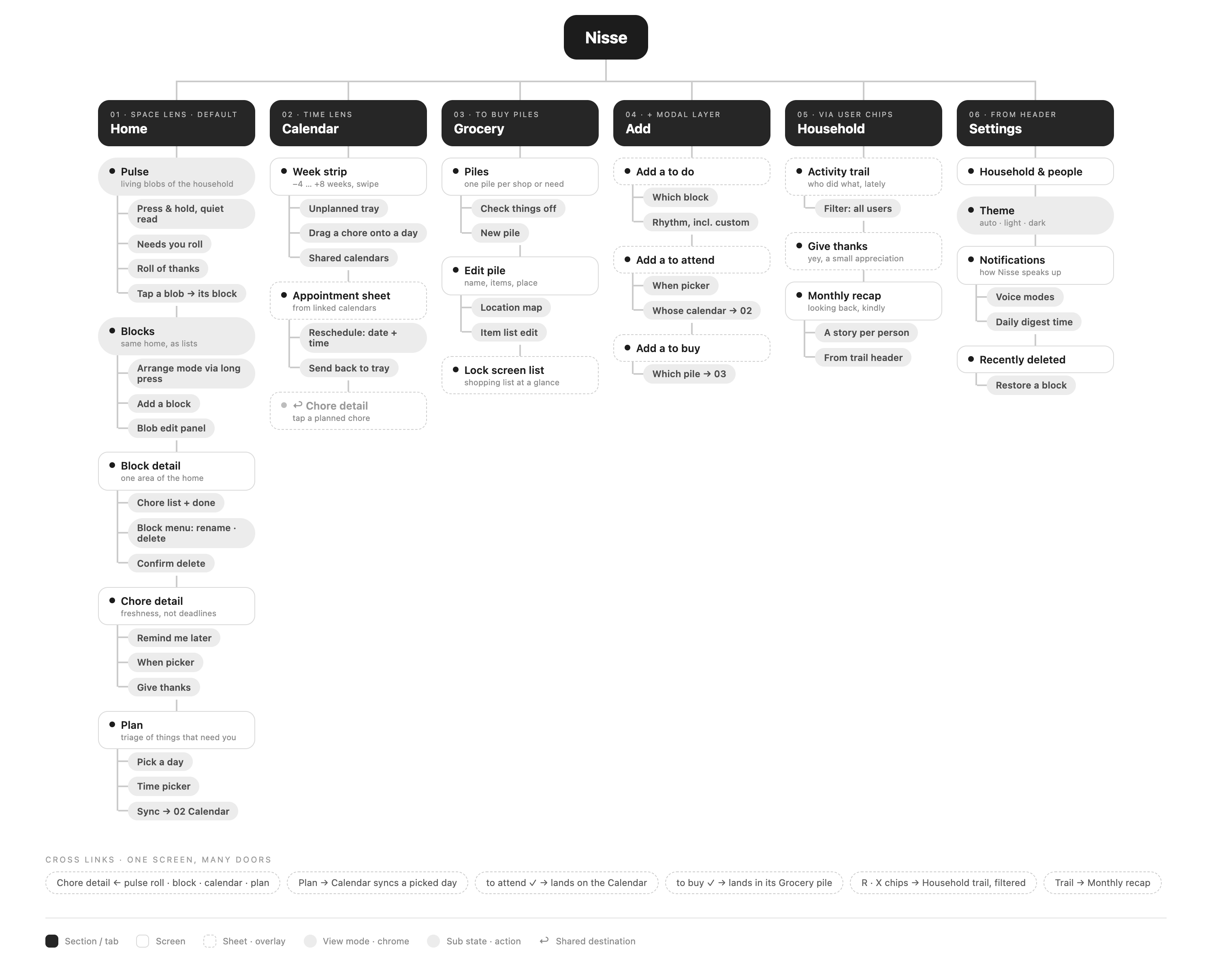
The screens
Below is the app as it stands, in three shelves you can slide through sideways. Everything shown here runs in the working build.
The home and its work
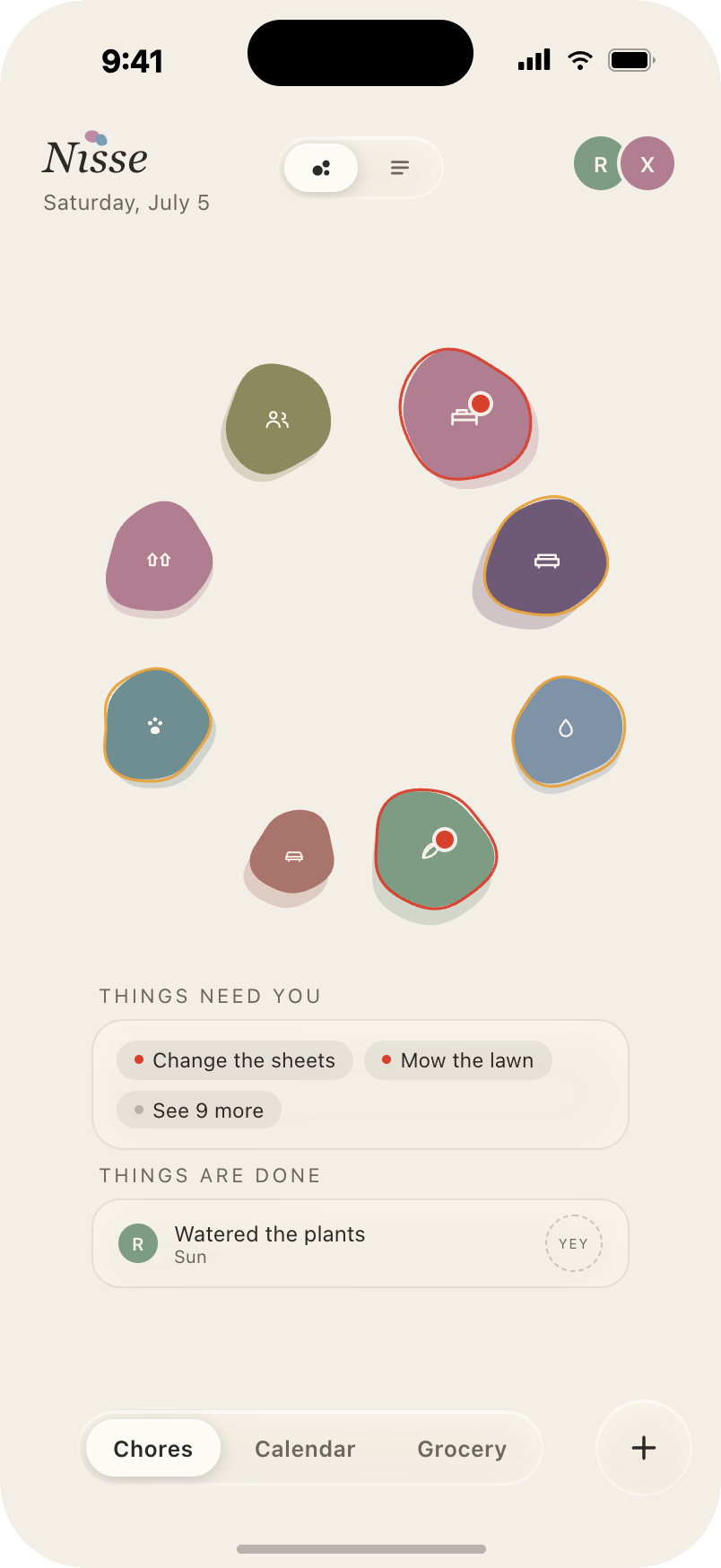
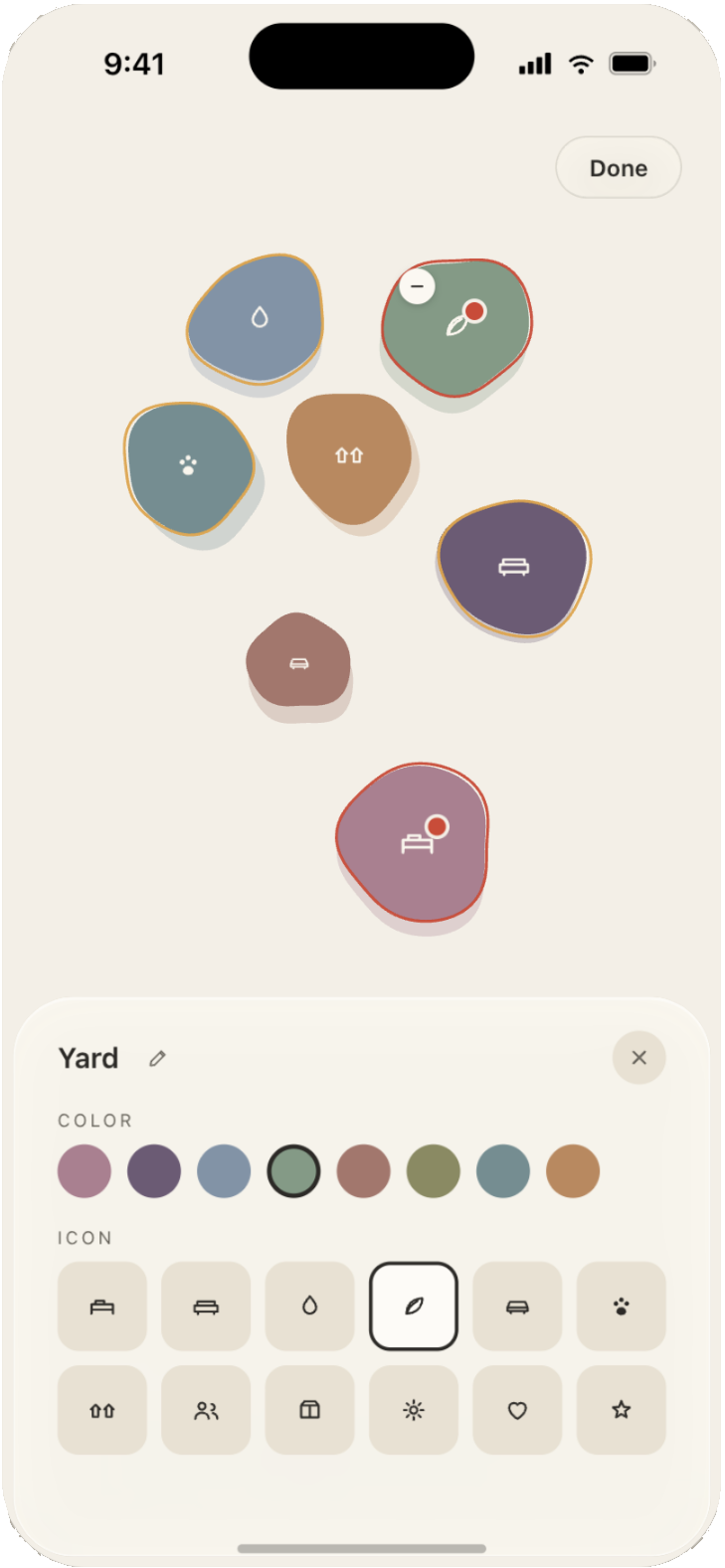
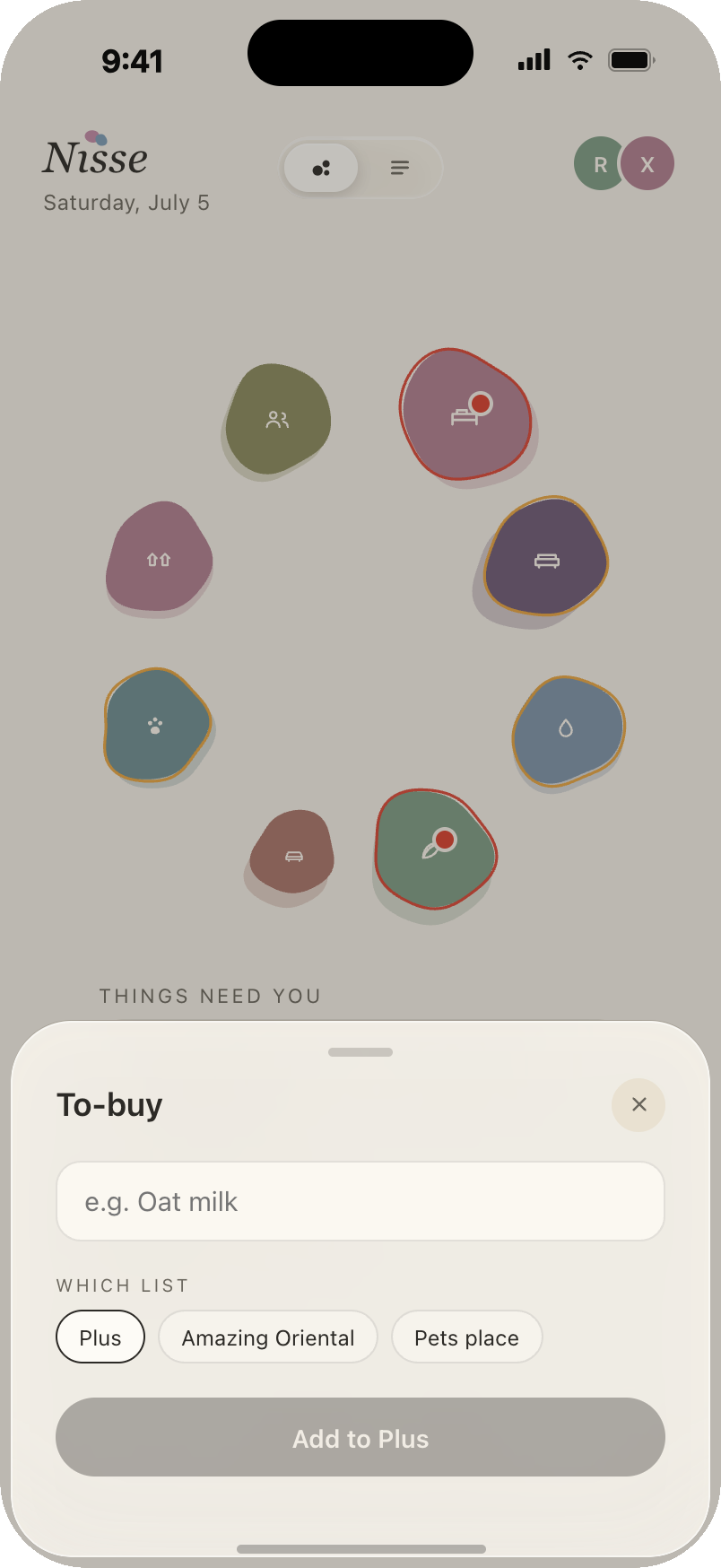
Home answers the question of how the household is doing: blobs sized by their open work, a quiet read on press and hold, and a list for the days you would rather scan than feel. Tap through a zone to a single chore and the whole philosophy sits on one screen, a rhythm card instead of a due date.
Time, capture and errands
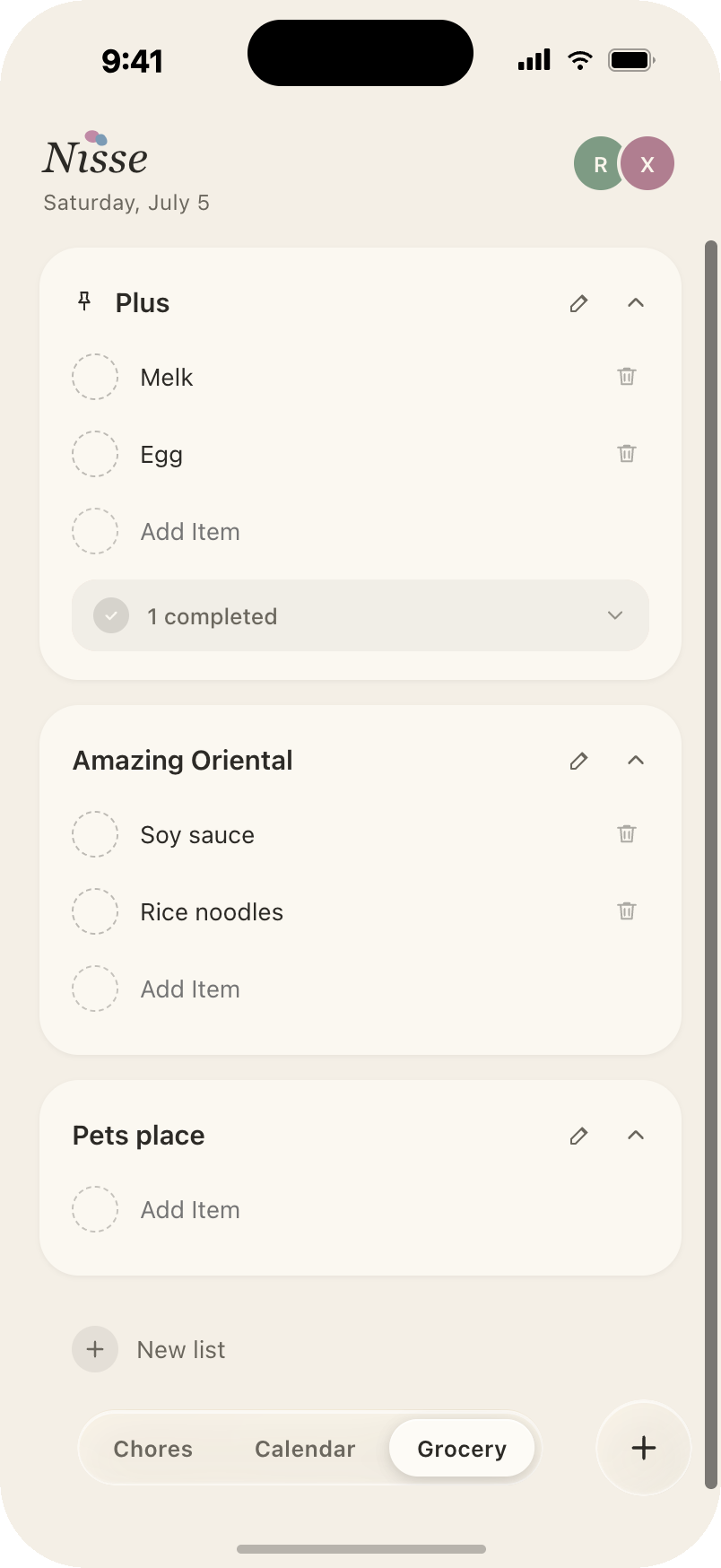
The week both of you share, the three capture sheets, and the piles. Planning is dragging a chore onto a day. Capture is one + button and the only typing Nisse ever asks for, with each sheet built to be closed within seconds.
The two of you, and the quiet parts
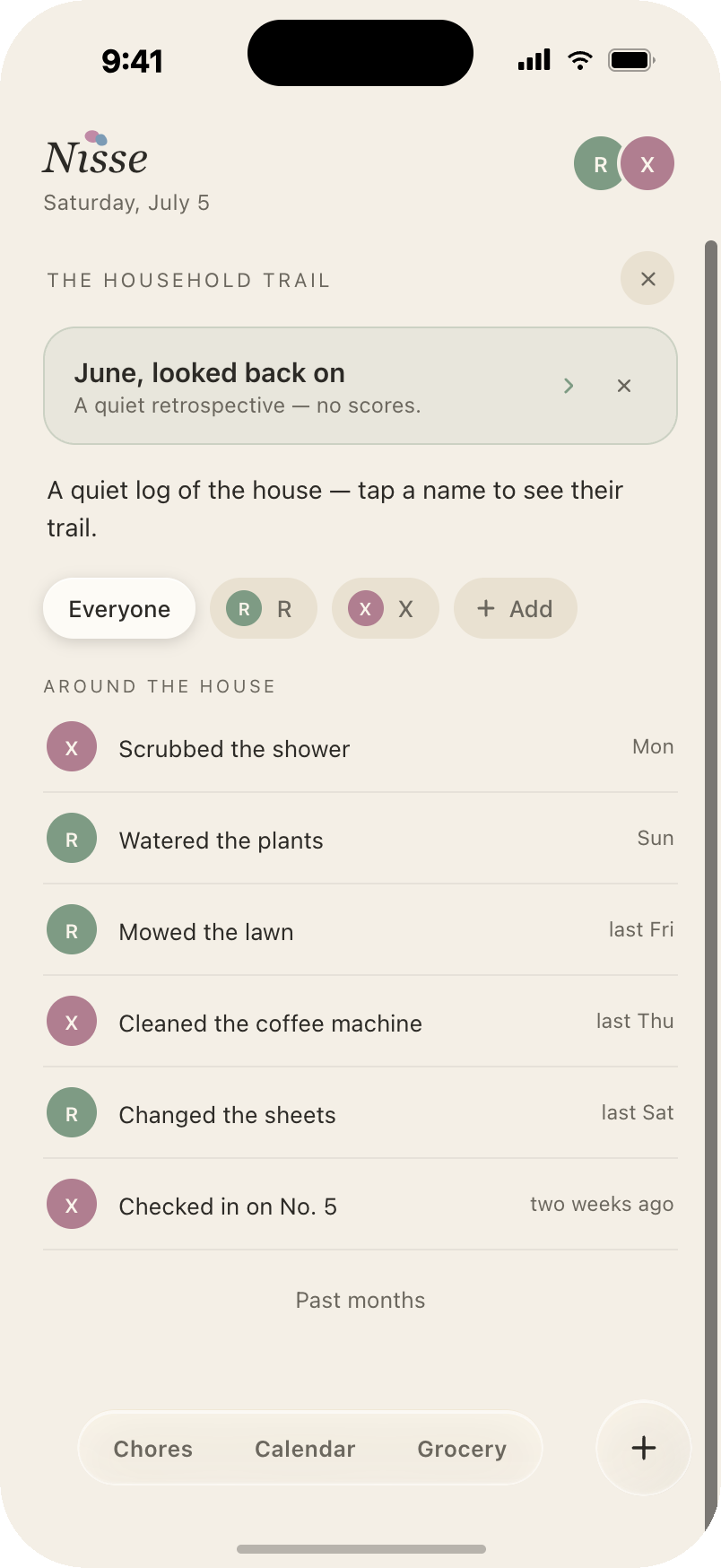
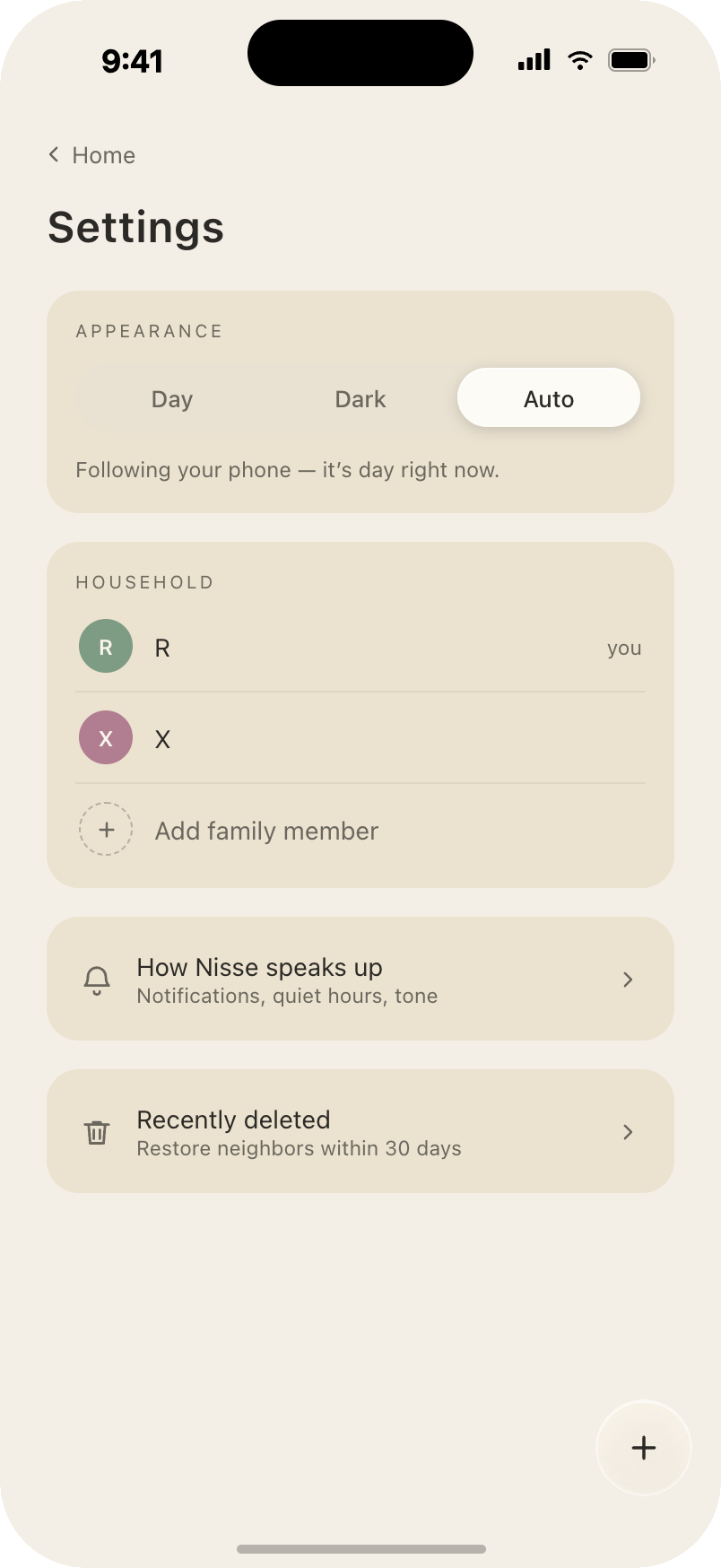
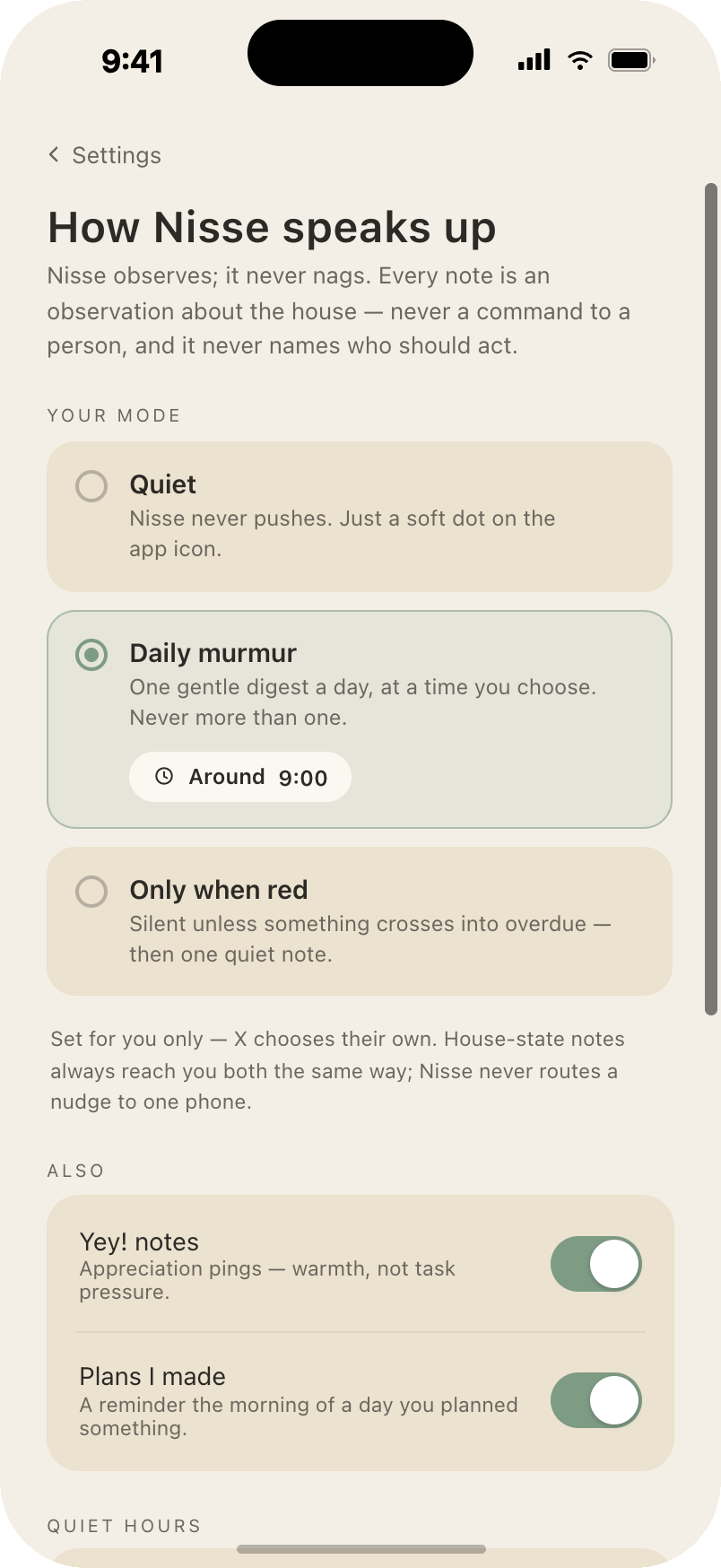
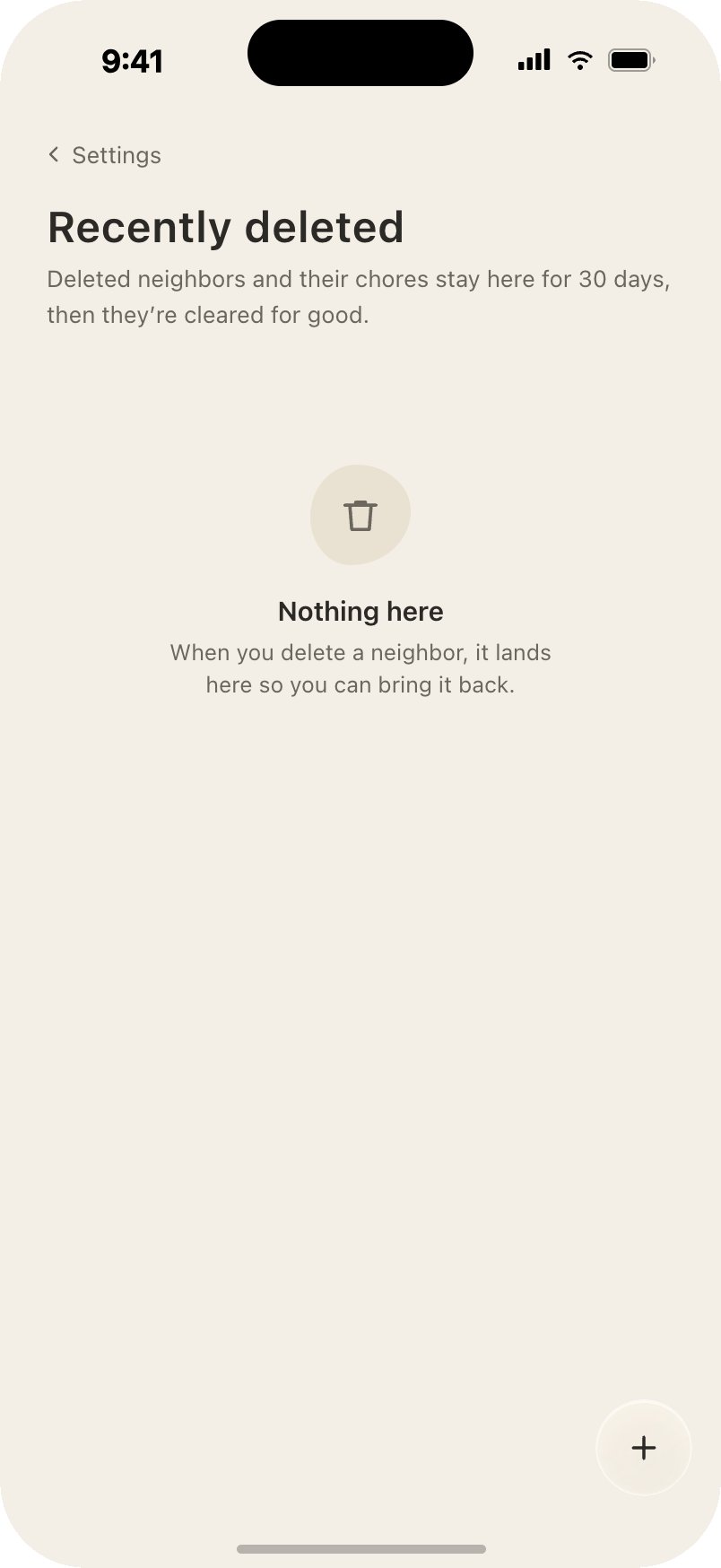
Behind the partner chips is the only place Nisse talks about people instead of chores: the trail of who did what, and a monthly recap told as a story rather than a score. Settings govern how softly Nisse speaks, and recently deleted keeps every removed zone restorable. Nothing a tired thumb does at midnight is permanent.
Removing “assign to” did more for fairness than any fairness feature could. Restraint, it turns out, has to be designed repeatedly. Calm has to be chosen again at every screen, against every instinct to add a number, a badge, or a pulse of motion. In emotional territory, words beat numbers: a home described as “mostly calm” starts a very different conversation than a home scored 73%. And abstraction turned out to be the honest choice, because the blobs never pretend to know your house. They only claim to know how much it is asking of you right now.
The same lessons apply to the way it was built. Working with Claude Code raised the price of weak design judgment, because the tool will happily build whatever you failed to think through. What comes next: visual explorations of the pulse pebble, a full prototype of the claim and promote gestures, and a real monthly cycle with real couples living with the fairness mirror, since a mirror can only be judged after a household has actually looked into it.
If this made you think about the invisible work in your own home, that is the point.