Background
The longitudinal study produced a framework for co-exploration in student design teams. The obvious follow-up was whether any of it transferred to professional practice, and whether remote work had changed things in ways that needed different kinds of support.
Research Objectives
Did the five co-exploration patterns hold in professional settings? And what did experienced designers think would actually help teams explore ideas remotely?
Methods
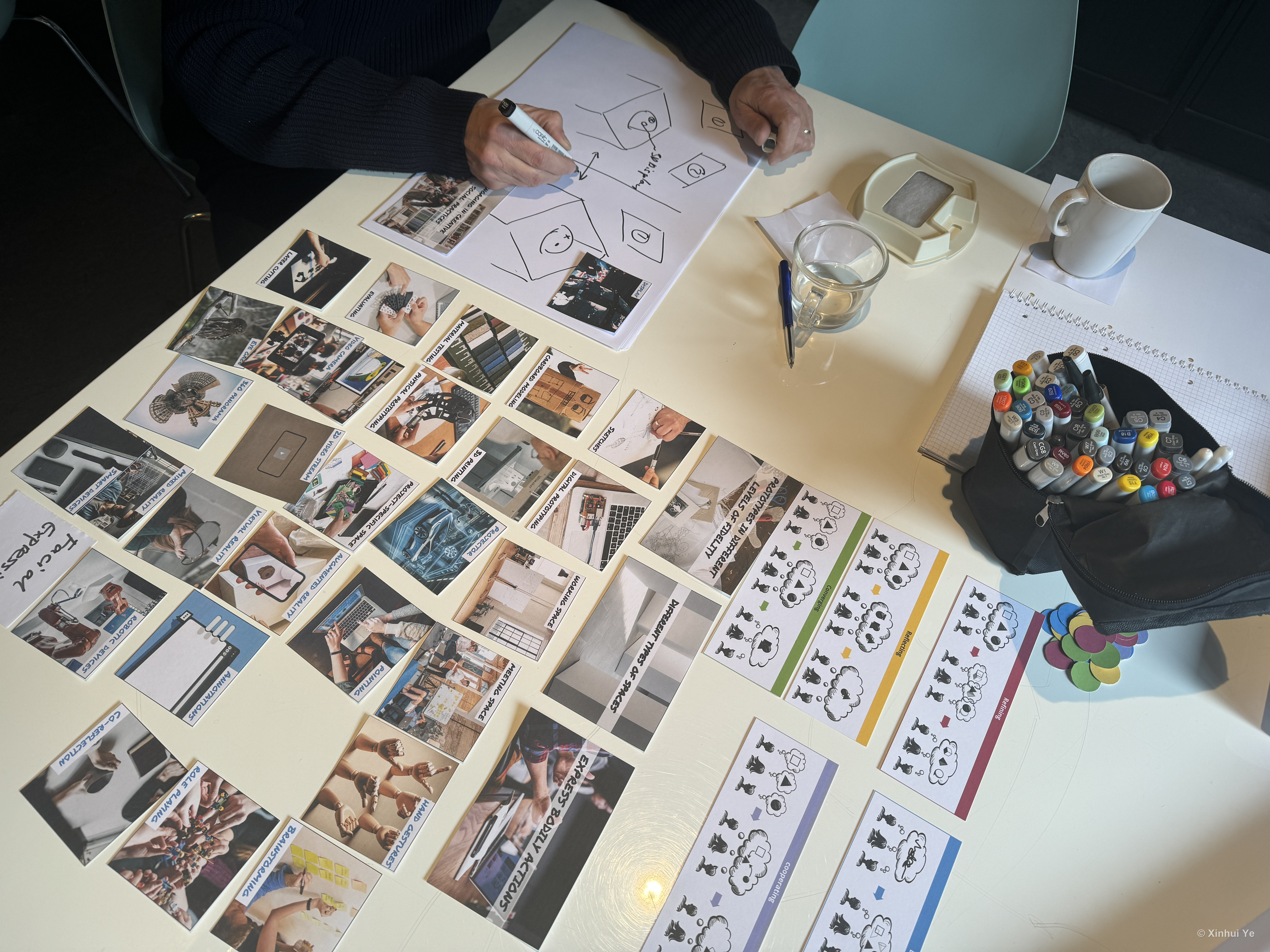
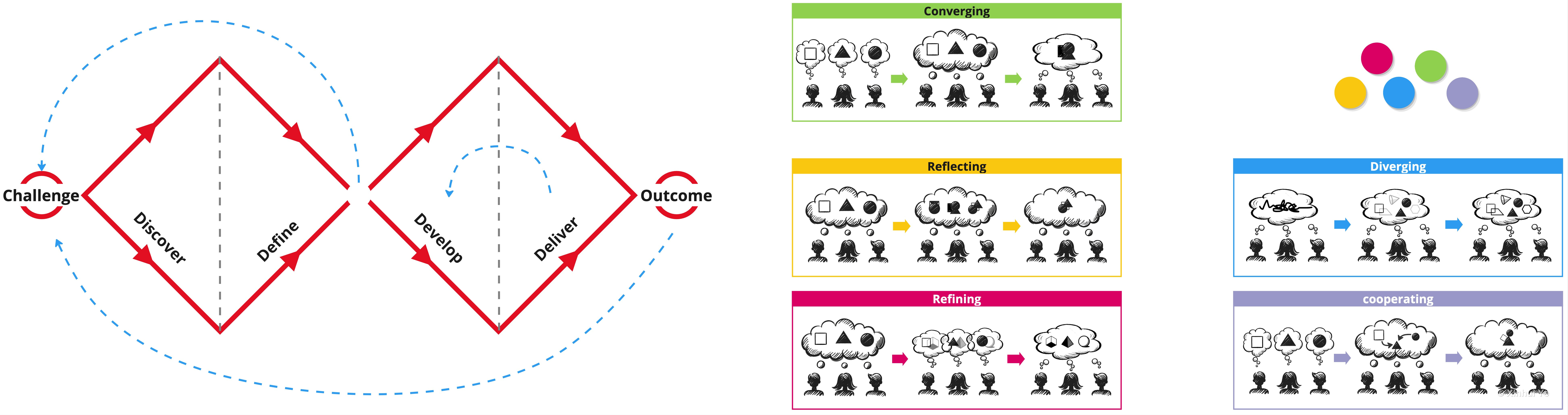
I interviewed eight design professionals, from design engineers to studio founders, with experience ranging from six to over thirty-five years, all with regular remote collaboration. Each session had two phases: an experience mapping exercise where experts placed color-coded pattern tokens on a Double Diamond model, then a speculative ideation session with 33 Inspiration Cards covering collaboration technologies, social cues, and spatial configurations. Experts sketched tool ideas on A3 posters. I collected 15 hours of audio and 24 idea posters across the eight sessions.
Findings
All five patterns held in professional practice. Experts recognized them in both co-located and remote settings, confirming that co-exploration is not confined to design education.
But remote work had affected both its execution and quality. Teams explored with less depth and breadth. Spontaneous moments reduced. Social interaction thinned. Informal exchanges, the kind that happen in passing or outside of scheduled meetings, had been compressed into fewer, more structured sessions. The process had not become entirely linear, but it had become less expansively exploratory.
The Inspiration Card sessions revealed how experts thought about addressing this. Their proposals clustered around the coordinated interplay of people, materials, and interactions across three collaborative spaces: where teams come together in meetings, where individuals work day to day, and where shared project materials and history accumulate. From these insights, I developed the Designing Tools for Co-exploration (DTC) guideline, which organizes this design knowledge into those three spaces, with considerations framed as questions rather than instructions. The DTC works both as a resource for tool designers and as a reflective aid for teams looking at their own practices.
| Spaces | Theme | Key Aspects |
|---|---|---|
| Meeting space | People | Contextual awareness of individual’s work-in-progress |
| Contextual awareness of project’s status | ||
| Individual preparation | ||
| Materials | Multi-fidelity prototypes | |
| Accessibility and synchronization | ||
| Meeting continuity | ||
| Interactions | Group-based techniques | |
| Maintaining enthusiasm and engagement | ||
| Expressing and understanding communication cues | ||
| Facilitating side conversation | ||
| AI-generated content | ||
| Working space | People | Informal encounters |
| Contextual awareness of individual’s work-in-progress | ||
| Contextual awareness of project’s status | ||
| Materials | Ambient creative stimulus | |
| Interactions | Informal social interactions | |
| Maintaining togetherness | ||
| Pre-meeting huddle | ||
| Expressing and understanding communication cues | ||
| Project-specific space | People | Contextual awareness of project’s status |
| Materials | Material archives for future reference | |
| Encouraging knowledge sharing | ||
| Accessibility and synchronization | ||
| Interactions | Traces of interactions with materials |
The five patterns survive remote work. The quality of them does not, and that is what the DTC is designed to address.